
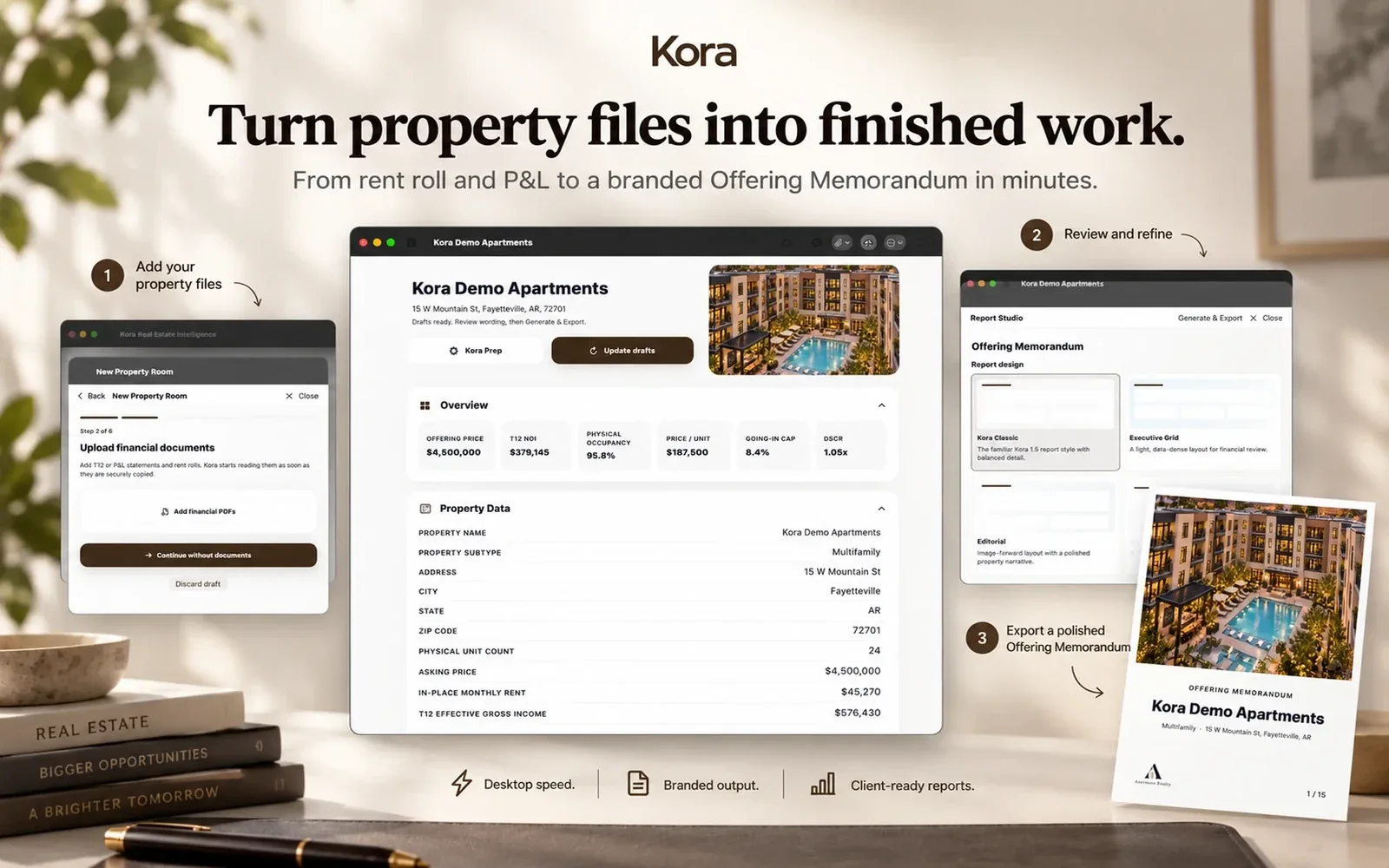
Example property and figures.
By Josh Tandy, Founder of Clairos
I spent seven years working as a real estate agent and supervising broker in Arkansas. During that time, I handled approximately $30 million in sales, operated a brokerage, and worked with properties ranging from ordinary residential listings to more complicated income-producing investments.
I learned a lot about real estate during those years. Particularly how much time agents spend doing things that have very little to do with helping their clients.
One problem drove me absolutely crazy.
Getting accurate, consistent property analytics into a client's hands while you're still standing in front of the property.
Not tomorrow. Not after you've gone back to the office, opened six spreadsheets, tracked down the tax records, and spent half your afternoon formatting a report.
Right there, when the client is asking the questions.
That's where Kora began.
The problem wasn't a lack of information
Real estate agents rarely suffer from a shortage of documents.
You've got MLS listings, tax records, rent rolls, profit-and-loss statements, handwritten notes, property photographs, financing terms, and an assortment of other information that somehow never arrives in the same format twice.
The problem is turning all of that into something useful.
For an income-producing property, I might need to evaluate operating expenses, calculate net operating income, explore financing scenarios, project returns, and prepare a presentation for a client.
None of those tasks is particularly mysterious. But collecting, organizing, calculating, verifying, and presenting everything takes time. Doing it consistently takes even more.
I wanted to eliminate as much of that repetitive work as possible without compromising the accuracy of the underlying analysis.
From a pile of documents to a property room
Kora starts with the information you already have.
Bring a rent roll, P&L, tax document, MLS listing, notes, photographs, or other available property records into a dedicated property room. Kora reads supported documents and extracts information for you to review. Handwritten or inconsistent material may need corrections; the source files stay with the property, and your manual values remain authoritative.
That room becomes the working center for the property.
From the reviewed information, Kora calculates property financials, financing breakdowns, and projections. Available market context from official sources sits alongside that analysis. You can explore hypothetical scenarios without confusing them with the property's actual operating history.
Want to explore a different interest rate? Change the financing assumptions. Compare potential returns? Work through the numbers.
The information is organized and available while you're sitting with your client.
And here's the part I would have loved when I was selling real estate:
In my own workflows, I've seen documents become a populated property room in less than a minute.
That is my experience, not a promise for every packet. Document length, scan quality, device, and connected services affect the time, and reviewing the extracted facts is still part of the job.
But having a working room ready to review, instead of an empty spreadsheet waiting to be filled, changes the conversation.
Why not just ask an AI chatbot?
It's a fair question.
You can upload a rent roll to a general-purpose AI system and ask it to calculate investment returns. Sometimes it'll do a perfectly respectable job.
But real estate analysis isn't an area where sometimes is particularly reassuring.
A convincing-looking answer can contain incorrect calculations, misunderstood figures, inconsistent assumptions, or information drawn from sources you didn't intend to use.
And reproducing the same analysis across different properties can become an exercise in prompt engineering.
I didn't want agents to have to become prompt engineers.
I wanted a predictable, repeatable workflow.
Kora uses AI for organizing information, summaries, and writing. It can help interpret extracted material and draft property copy, briefings, and report narratives. It does not make a poor scan reliable by decree. You can check the source and correct the result.
That written content remains reviewable and editable.
The financial calculations themselves are handled through structured analytical logic rather than asking a language model to invent the math.
The objective isn't to make AI the center of the experience.
It's to make the work easier.
From analysis to presentation
Getting the numbers right is only half the job.
Clients need to understand what those numbers mean, and agents need to present them professionally.
Kora can use the same organized property information to produce branded financial reports, marketing flyers, and offering memorandums.
An offering memorandum can run thirteen pages or more, with property information, financial analysis, photographs, and the agent's branding. Its length depends on the property and the material included.
In my own workflows, generation has taken around two and a half minutes. That is an approximate expectation, not a stopwatch guarantee; the amount of material and the services involved matter. Reviewing the information and final document takes its own time.
The flyer generation engine is intentionally deterministic. AI may help draft the descriptive language beforehand, but the actual layout and assembly aren't left to a generative model.
That matters to me.
I don't want an AI inventing a new interpretation of someone's logo, rearranging financial figures, or deciding a property needs an architectural feature that doesn't exist.
A professional marketing document should look professional because it was designed carefully, not because a model happened to get lucky.
When I was working in real estate, gathering the information, preparing the analysis, and producing those materials could take hours. I also paid for separate tools and services that added more than $100 a month in expenses.
Kora brings much of that work into one place.
A property doesn't exist in isolation
One of the most common things a client asks about isn't necessarily the property itself.
It's the area.
What's nearby? What businesses are around? What's the local rental market like? What does the surrounding economy look like?
Those questions matter, especially when evaluating investment property.
Kora includes location intelligence inside the property room.
It brings available nearby places, maps, and surrounding-area context into the room. Federal housing and economic data can include rental vacancy, renter share, median household income, median gross rent, and unemployment.
Those figures do not all describe the same area. Census housing statistics and labor-market data may cover a tract, city, county, or metropolitan area, with different reporting dates. Kora keeps the available source, geography, and timing in view.
A county unemployment figure is not a measurement of the street you are standing on. And no collection of statistics tells you everything about a neighborhood.
I want agents to have useful context without another afternoon of website hunting, and enough information about the sources to understand what that context can tell them.
Residential agents shouldn't need a separate philosophy
After developing the core analytical workflow, I adapted the same general approach for residential real estate.
Create a property room. Upload the MLS listing, tax information, notes, photographs, and whatever other relevant information you have.
Kora organizes the material into a property workspace and helps prepare listing copy, branded flyers, open-house materials, social graphics, and presentations. Location intelligence is available there, too.
The underlying philosophy is the same whether you're reviewing an income-producing property or preparing a residential listing:
Start with the information you have. Make it useful. Make it presentable. Don't create unnecessary work.
The smallest feature might make the biggest impression
There's one feature of Kora that I suspect some agents will initially overlook.
During setup, you can add your logo, headshot, contact information, and brand colors, along with existing marketing material to help establish your branding.
Kora carries that identity into supported reports and marketing. Inside the app, your logo, name, and chosen theme help make the workspace feel like it belongs to your business.
Now imagine you're meeting a client at a property.
You open Kora on your iPad to review the numbers, and the client looks over at your screen.
They see your branding in the workspace.
Your logo. Your name. Your colors.
For that moment, it feels like your own application.
That might sound like a small detail, but having spent years working with clients, I can tell you that presentation matters. Organized information, answers you can find, and materials that look like they belong to your business make an impression.
Sometimes those little moments do more than an elaborate sales pitch.
And I wanted independent agents to have access to that kind of experience without having to commission their own software.
What I actually wanted to build
I didn't build Kora because I thought the world needed another real estate calculator.
There are plenty of those.
I built it because I remembered standing in front of clients, knowing the information existed somewhere, and wishing I could bring it all together quickly enough to have the conversation right then.
I remembered the hours spent assembling reports, the subscriptions to disconnected services, and the repetitive work that always seemed to happen between understanding a property and actually presenting it.
Kora is my attempt to remove that distance.
Not by replacing an agent's judgment, but by giving that judgment better information and better tools.
Real estate will always involve complicated decisions. It should.
But the software you use to understand those decisions doesn't have to be complicated.
And if it can make you look a little more prepared in front of a client?
Well, having been on that side of the table, I certainly won't apologize for that.
— Josh Tandy
Founder, Clairos
Explore Kora Intelligence on the App Store.