The Problem with Modern Weather Apps
If you open a mainstream weather app today, you aren't just checking the temperature. You are navigating a gauntlet of autoplay videos, "suggested articles" about climate trends you didn't ask for, AI-generated summaries that hallucinate the "vibe" of the afternoon, and aggressive ad placements that obscure the actual radar. What was once a simple utility has been transformed into a content feed designed to capture your attention for as long as possible.
Weather apps have shifted from being utilities to being engagement engines. The goal is no longer to tell you if it's raining in thirty seconds; the goal is to keep you in the app for three minutes so they can serve you an ad for an umbrella or a sponsored piece of 'lifestyle' content. This is a fundamental failure of tool design. A utility should be a window—clear, transparent, and easy to look through—not a billboard that requires you to fight for the information you actually came for.
When we first built Weather Direct, the mission was simple: Official data. Zero noise. We wanted a tool that provided the critical information you need to plan your day without the cognitive tax of modern software bloat. We believed that checking the weather should be a low-friction event, not a digital chore. Today, we are bringing that same philosophy to the open web.
Introducing weather.clairos.ai
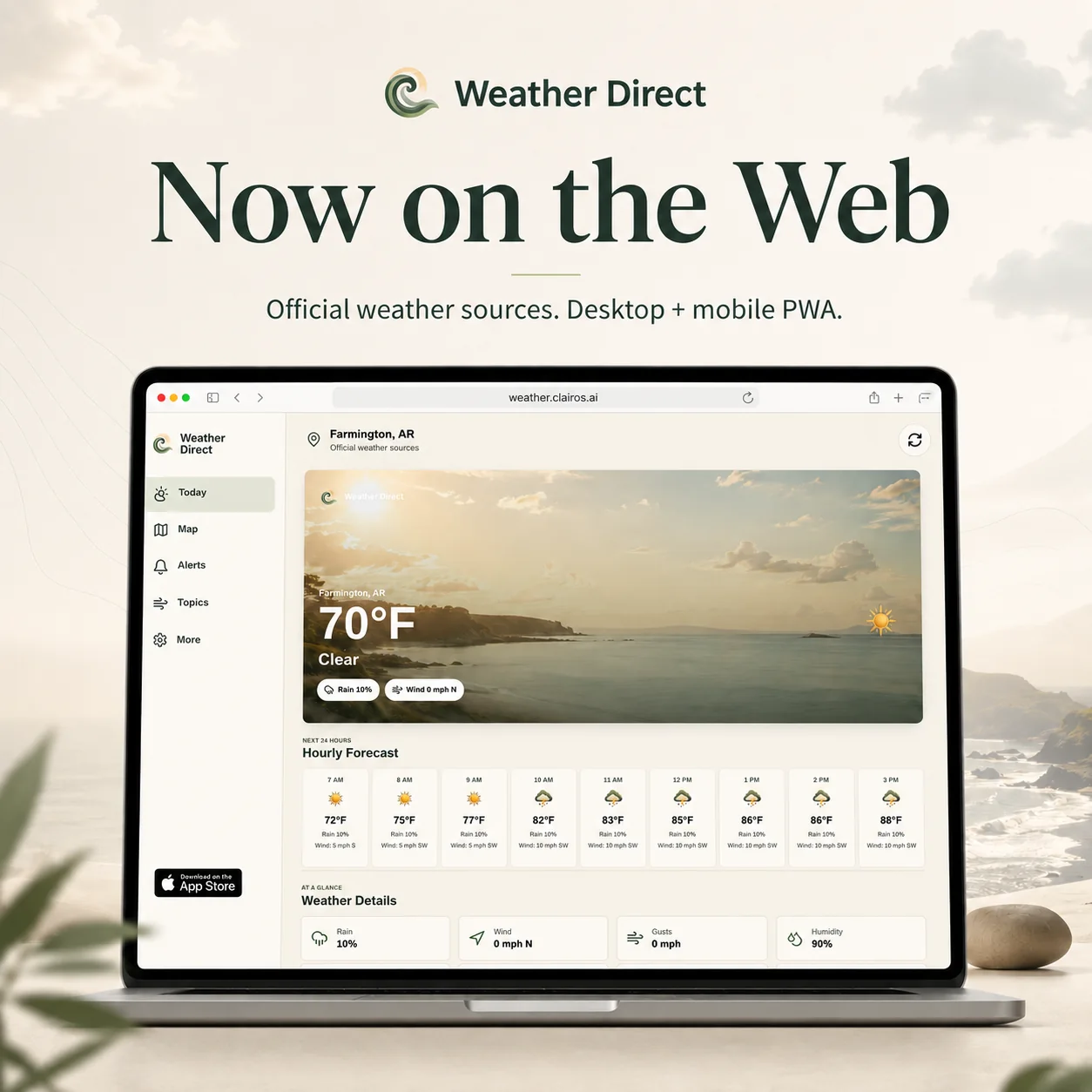
We are excited to announce that Weather Direct is now live on the web at weather.clairos.ai. This isn't just a mirrored website or a simplified landing page; it is a Progressive Web App (PWA) designed to behave like a native application while remaining accessible from any browser. By leveraging the PWA standard, we've created a bridge between the accessibility of the web and the performance of a local app.
By moving Weather Direct to the web, we are removing the friction of app store downloads for those who just need a quick, reliable check of the conditions. But more importantly, we are proving that high-performance, data-dense utilities can exist on the web without compromising on speed or privacy. You can now access the same core experience—forecasts, alerts, and radar—without needing to manage another app installation on your mobile device.
What Makes Weather Direct Different?
Most weather services operate on a model of data-harvesting and attention-capture. They treat your location as a product to be sold and your attention as a resource to be mined. Weather Direct operates on a model of pure utility. Here is exactly what that means for the user experience:
- No Accounts, No Analytics: You don't need to sign up, log in, or agree to a 40-page Terms of Service just to see if you need a coat. We don't track your movements, we don't build a profile on your habits, and we certainly don't sell your location data to third-party brokers. Your request for data is a transaction, not a data-mining opportunity.
- Zero Ad Clutter: There are no banners, no sponsored content, and no autoplay videos. Every pixel of the interface is dedicated entirely to weather data. When you look at the radar, you are seeing the weather, not an ad for a local car dealership overlaying the storm front.
- Official Data Sources: We don't use "estimated" data or proprietary black-box models that prioritize engagement over accuracy. We pull from official meteorological sources, providing you with the raw truth of the forecast as reported by the agencies responsible for the data.
- Tropical Storm Awareness: For those in vulnerable regions, we've integrated specialized NHC (National Hurricane Center) tracking. This provides clear, actionable awareness during tropical events without the sensationalism and "fear-click" headlines found in mainstream news feeds. It is data for the purpose of preparation, not for the purpose of panic.
The Engineering Behind the Quiet
Building a "quiet" tool requires more intentional engineering than building a loud one. To make weather.clairos.ai feel instantaneous, we've focused heavily on the infrastructure layer. We've implemented streamlined Nginx routing for our data ingests—including MET, NHC, and TMD sources—to ensure that the path from the weather station to your screen is as short as possible. By optimizing these routes, we reduce latency and eliminate the middle-man processing that often slows down web-based utilities.
By utilizing a PWA architecture, you can "Install" Weather Direct directly from your browser to your home screen or desktop. This gives you the speed of a native app—including a clean, standalone window without browser tabs or address bars—while maintaining the portability of the web. It is a modular approach to software that aligns with our broader belief in the rise of the quiet tool. We believe that software should be a tool you pick up to solve a problem and then put down immediately, rather than a destination that tries to trap you in a loop.
Why the Web Matters for Utilities
For too long, the "app-ification" of the internet has forced users into silos. If you want a specific utility, you are often forced to go to a store, authenticate your identity with a biometric or password, and grant a dozen permissions just to access a simple function. This creates a "surveillance tax" on basic information, where the cost of the "free" app is the surrender of your privacy.
By launching on the web, we are reclaiming the original promise of the internet: a decentralized web of tools that are available to anyone, anywhere, instantly. Whether you are on a laptop in an office, a tablet in a workshop, or a phone in the field, the information remains the same, and the experience remains uncluttered. The web is the only truly universal platform, and for a utility like weather, that universality is a feature, not a compromise.
The Broader Philosophy of Utility
Weather Direct is part of a larger effort at Clairos to build software that respects the user's time and mental space. We see a growing trend of "feature creep" where simple tools are bloated with unnecessary AI summaries and social integrations. While AI has its place in complex analytical work—as we've explored with the analytical engine inside Kora—it has no place in a weather forecast. You don't need an AI to tell you it's "a bit chilly out there"; you need the exact temperature and the wind speed so you can make your own decision.
This commitment to clarity extends to our entire product suite. Whether it's a mathematical laboratory or a weather dashboard, the goal is to provide the highest possible signal-to-noise ratio. When the software disappears and only the data remains, that is when the tool is working correctly.
Get Started
The next time you find yourself fighting a weather app—scrolling past ads, waiting for a video to load, or wondering why it's asking for your email address just to show you a five-day forecast—try a different approach.
Visit weather.clairos.ai and experience what happens when the noise is removed. No accounts to create, no data to sell, and no distractions to navigate. Just the weather, exactly as it is.
No ads. No accounts. No clutter. Just Weather Direct.