The Death of the Utility App
For a long time, a weather app was a simple tool. You opened it, you saw if it was raining, and you closed it. The interaction was binary: you had a question, the app provided a data point, and the transaction was complete. But over the last decade, the 'utility app' has been systematically cannibalized by the attention economy. Today, opening a mainstream weather app is less about checking the temperature and more about navigating a minefield of autoplaying video ads, sensationalist 'breaking news' banners, and AI-generated summaries that tell you it's 'a beautiful day for a walk' while ignoring the actual atmospheric data.
We call this the engagement tax. The software is no longer designed to give you information efficiently; it is designed to keep you scrolling. When your tool for checking a hurricane warning starts trying to sell you a subscription to a lifestyle magazine or pushes a clickbait video about a 'strange cloud formation' in another state, the tool has stopped serving you. It has started serving its advertisers. This shift represents a fundamental betrayal of the user's intent. You aren't a 'user' to these platforms; you are a set of eyeballs to be monetized via dwell time.
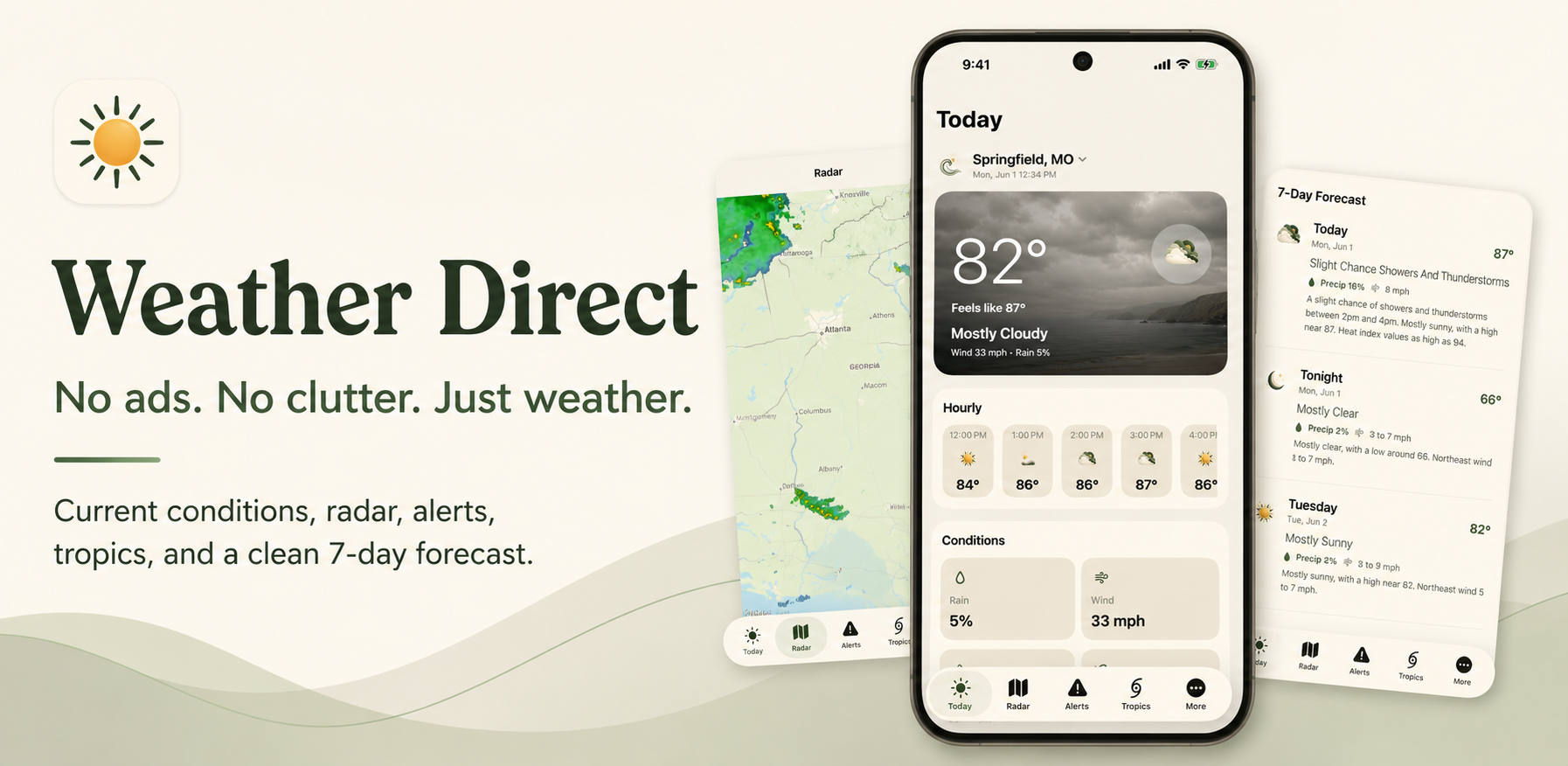
Weather Direct is our response to that drift. It is not an incremental improvement on existing apps; it is a rejection of the current trajectory of mobile software. We believe that when you want to know the weather, you are seeking a fact, not a content experience.
A Surgical Strike Against Clutter
Weather Direct isn't just another weather app; it is a deliberate exercise in subtraction. In the modern development cycle, the instinct is almost always to add: add a social feed, add a 'smart' assistant, add a gamified reward system. We did the opposite. We didn't ask 'what features can we add?' Instead, we asked 'what can we remove until only the truth remains?'
The result is a premium, coastal-inspired experience that prioritizes calm over chaos. We've scrubbed the 'clouds'—the visual and cognitive noise that clutters the modern screen. There are no ads. There are no tracking feeds. There are no autoplaying videos. There are no 'AI assistants' paraphrasing the forecast into a conversational tone that obscures the actual numbers. It is just the data, presented with structural rigor and a visual palette designed to lower your heart rate, not raise your engagement metrics.
This commitment to minimalism is a core tenet of our broader philosophy. As we've discussed in Quiet Software, the most powerful tools are those that stay out of your way until the exact moment you need them, and then deliver the answer without friction. Weather Direct is the embodiment of this principle. It is a tool that respects your time and your intelligence.
The 'Direct' Philosophy: No Middleman
The most radical part of Weather Direct isn't the UI—it's the architecture. To understand why this matters, you have to understand how most weather apps actually work. Most act as a proprietary middleman. They pull data from a public source, run it through their own servers, wrap it in a tracking layer for telemetry and advertising, and then serve it to you. This creates a dependency on the app's own backend and introduces a layer of potential failure and data harvesting.
Weather Direct v1 has no backend.
It doesn't play middleman. The app fetches data directly from official public sources on your device. By removing the server-side abstraction, we've created a tool that is faster, more private, and more resilient. When you use Weather Direct, you are communicating directly with the agencies responsible for the data. There is no 'Clairos Server' sitting in the middle modifying the data or logging your location for a third-party broker.
The app connects directly to the following authorities:
- The National Weather Service (NWS): Point metadata, official forecasts, hourly data, and severe weather alerts via
api.weather.gov. - The National Hurricane Center (NHC): Real-time status and tracking for active tropical cyclones via
nhc.noaa.gov. - NOAA: Official radar and satellite cloud imagery via
nowcoast.noaa.gov.
This architecture is a practical application of Local First principles. By shifting the logic to the edge (your device), we reduce the energy footprint of the software and maximize the sovereignty of the user. You aren't renting a view of the weather; you are accessing the official record directly.
Designed for the Critical Moment
While the app is a joy to use for daily checks, it was built with the 'critical moment' in mind. When a severe weather event or a hurricane is imminent, you don't need a 'lifestyle experience' or a curated feed of news stories. You need a reliable instrument. We've focused heavily on severe weather awareness, ensuring that alerts are prominent and the radar is high-fidelity.
Because the app communicates directly with NOAA and NWS, you aren't waiting for a third-party API to update its cache or for a corporate server to push a notification. You are seeing the official record as close to the source as possible. This is the difference between a 'weather app' and a 'weather tool.' One is designed to entertain you while you wait for the storm; the other is designed to help you prepare for it.
Furthermore, by emphasizing local-first caching, the app remains useful even when connectivity becomes spotty—a common occurrence during the very storms you're tracking. When the cell towers are strained and the 'cloud' is unreachable, Weather Direct relies on the last known official data stored on your device, ensuring you aren't left staring at a loading spinner during a crisis.
The Bigger Picture: Sovereignty Over the Noise
Weather Direct is part of a larger ecosystem of tools we are building at Clairos. Whether it's a real estate calculator or a mindful journaling space, the goal is always the same: returning sovereignty to the user.
We believe that software should be an extension of your intent, not a competitor for your attention. For too long, we have accepted the 'surveillance tax'—the idea that in exchange for a free utility, we must surrender our data and our focus. We are done with that trade. By scrubbing the 'clouds' of corporate bloat and engagement bait, we can return to a world where a tool is just a tool. No noise, no distractions—just the direct path to the information you need to navigate your day.
This is why we are championing Digital Minimalism. It's not about having fewer apps; it's about having apps that do one thing perfectly without trying to colonize the rest of your digital life. Weather Direct does one thing: it gives you the weather. And it does it with a level of purity that is increasingly rare in the modern App Store.
Get Weather Direct
Weather Direct is now live and available for download. It is free, it is clean, and it is direct.
Download for iOS: App Store
Download for Android: Google Play Store
To dive deeper into the technical specifications and the vision behind the project, visit the Weather Direct Product Hub. If you want to see how this fits into our wider philosophy of low-friction, high-utility software, explore the Clairos App Hub.
Stop scrolling through the noise. Get the data. Get direct.