
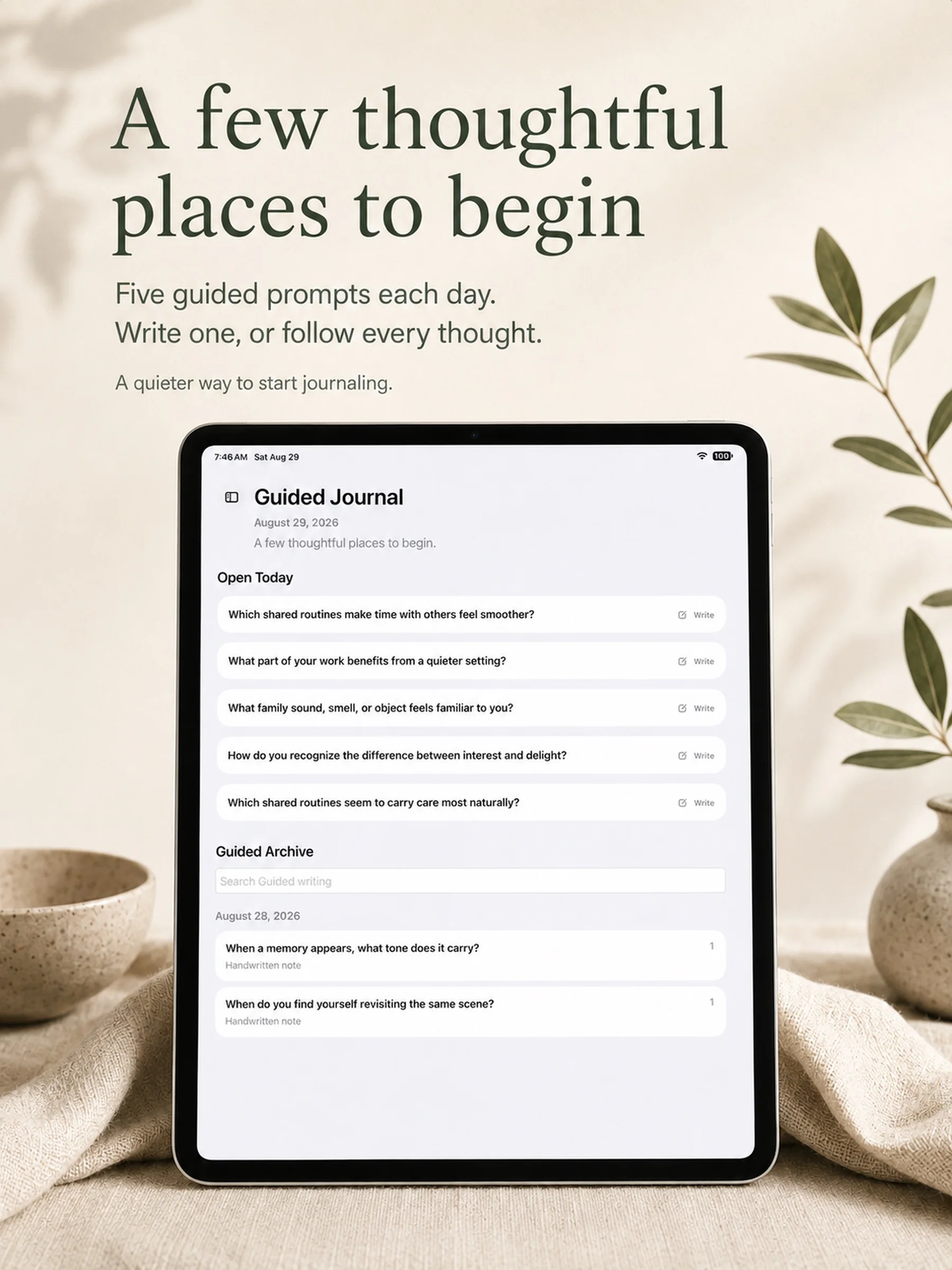
You open Journal - From Me on your iPad. A clean page appears. No blinking cursor with judgment, exactly. But the instruction "write something" is still sitting there, and it might be the worst instruction in any language. It has no shape, no edge, no place to put your first word.
Why a bounded prompt is easier than "write anything"
An open page can ask you to choose several things at once: the topic, the tone, the length, the ending. A prompt removes some of those choices for you. You still decide what to say and how far to go, but the opening move is already made. That's the whole trick. A prompt is a door, not a cage.
Guided Journal and Yesterday, Through You both do this. The difference is where they aim.
Inward vs. outward
Guided Journal offers five daily prompts with independent saved, editable responses and a Guided archive. The prompts tend toward the personal: something you noticed, something that shifted, something you'd like to think about more clearly. You're writing about your own experience, your own interior weather.
Yesterday, Through You offers seven daily story-inspired reflection prompts with independent pages and history. The prompts lean outward: a situation in the world, a question about how you relate to something that isn't you. You're still writing from your own perspective, but the subject is the world pressing against you rather than the quiet interior.
Neither mode is better. Choose the direction that fits the day: a thought of your own, or something in the world you want to consider.
The actual writing
A prompt settles where to begin. You may still catch yourself trying to write the right answer. There isn't one. A prompt is a starting point, not a test or an assignment.
A few moves that tend to work:
- Start with one concrete detail. Not "I felt sad." A specific thing: the way the kitchen light hummed at 6 a.m., the exact phrase someone used, the temperature of the coffee you didn't drink. A concrete detail gives you something specific to describe before you decide what it means.
- Follow the thought beyond the prompt. The prompt is the first step. If your answer leads into a different question, you can follow it. The useful thread may be the one you did not expect. The prompt doesn't own the page.
- Stop when you've said enough. You don't need to fill the page. Three honest sentences are better than a paragraph of performance. You can always come back and add to an entry later; the pages are editable.
These are optional starting points. You can write one line and close the app. You can also leave the prompt alone and use an ordinary journal page instead. The page is yours either way.
Your writing stays yours
Your journal entries are not sent to the public prompt service. The Guided prompt request uses the date needed for that bundle, rather than the contents of your response. Writing is kept in the app's local-first document system and can sync through private iCloud when you choose it; the public prompt service does not need to read your journal.
What's free, what's optional
The core journal experience is free: creating pages, writing, editing, searching your entries, organizing with folders, and exporting your writing. Guided Journal and Yesterday, Through You are optional features unlocked through a subscription. If you subscribe, write some reflections, and then your plan ends, your saved reflections remain available. You don't lose what you wrote.
A few hypothetical starts
To make this less abstract, here are a few hypothetical prompts in the spirit of each mode. These are writing examples, not today's app prompts or current news:
- What's a small decision you made this week that surprised you? (inward)
- When did you last notice a place changing, and what did it make you want to say? (outward)
- What's something you're carrying that you haven't named out loud yet? (inward)
Pick the one that nags. That's your signal.
You don't need a streak or a daily quota. Start with one thought you would like to look at more closely. Find Journal - From Me on the App Store. In the app, choose a prompt or open an ordinary page and begin with a concrete detail.