
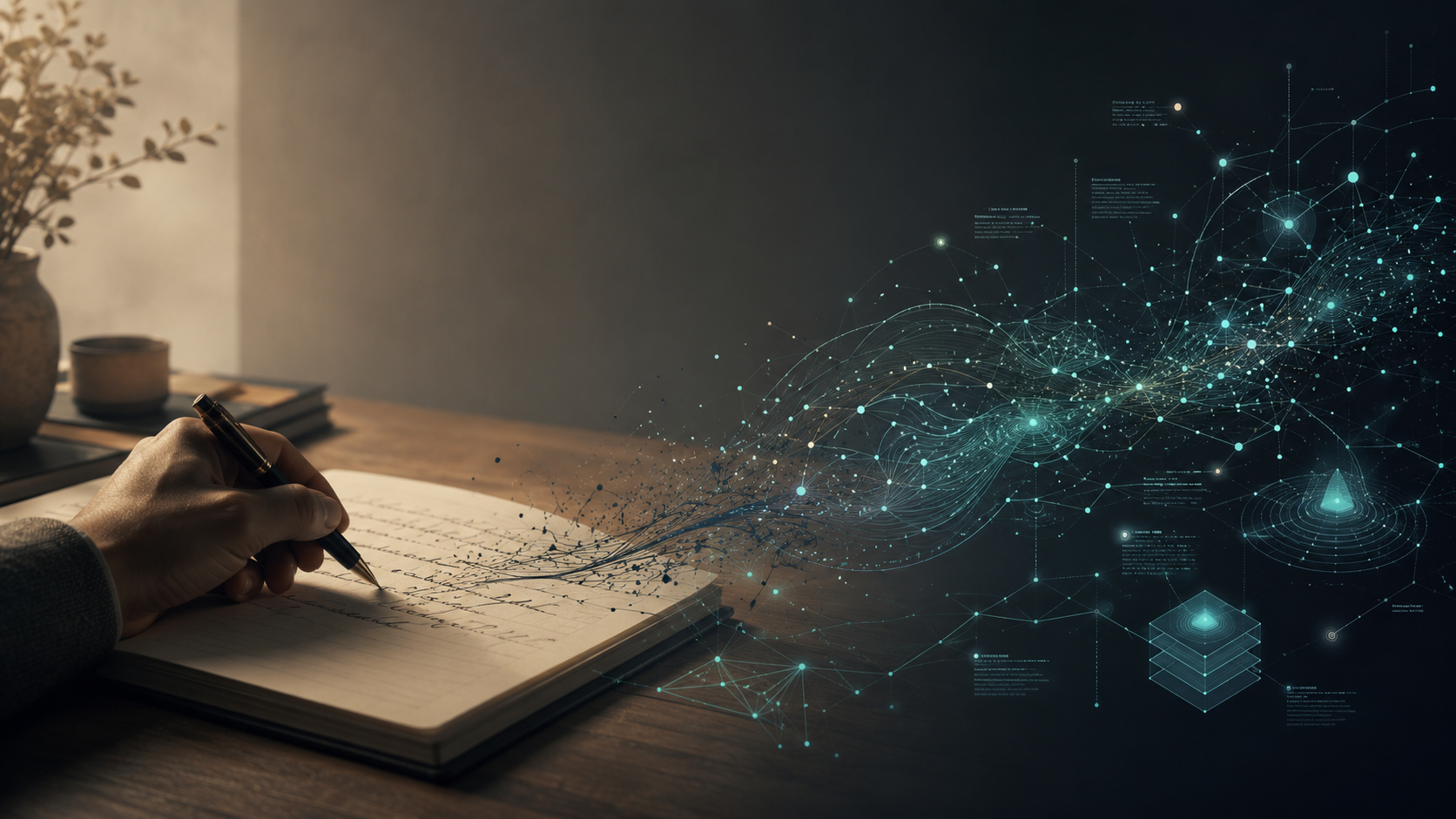
The Handwriting Hypothesis: Why We Must Stop Transmitting and Start Transforming
Moving beyond the 'Collector's Fallacy' to reclaim the cognitive power of the pen.
We have mistaken the ability to store information for the ability to know it.
In the modern professional workflow, we are obsessed with "capture." We have an app for everything: we clip articles to read later, use voice memos to record fleeting insights, and employ high-speed keyboards to transcribe meetings with surgical precision. We are creating vast, shimmering digital archives of everything we have ever encountered—a personal library of Alexandria stored in the cloud.
Yet, there is a haunting paradox at the center of this efficiency. Despite having more "captured" data than any generation in human history, we often find ourselves unable to recall the core insights of a note written just last month. We have the record, but we lack the memory. We have the data, but we lack the knowledge.
This is the Collector's Fallacy: the false belief that "collecting" a piece of information is the same as "integrating" it into our understanding. By optimizing for the speed of capture, we have inadvertently optimized for the speed of forgetting.
The Transmission Trap: The Cost of Low Friction
To understand why we are forgetting, we have to look at the interface. Typing is not an act of synthesis; it is an act of transmission.
The keyboard is designed for volume, speed, and efficiency. When we type, our primary goal is to move data from the brain to the screen as quickly as possible. Because the friction is so low—the keys are uniform, the movement is minimal, and the speed is near-instant—the brain treats the process as a clerical task. It is data entry, not deep work.
When the friction of recording is too low, the brain offloads the cognitive burden to the tool. We tell ourselves, "I don't need to fully process this right now, because I'm recording it perfectly." In doing so, we bypass the very neural pathways required for long-term retention. We aren't thinking; we are simply transmitting. We have become high-speed conduits for information that never actually settles in our minds.
The Handwriting Hypothesis: Friction as a Feature
The Handwriting Hypothesis suggests that the physical act of writing is not merely a different way of recording data, but a fundamentally different way of processing it. Unlike typing, handwriting is intentionally slow. In a world obsessed with optimization, we view this slowness as a bug. But in the context of cognition, this friction is the primary mechanism of learning.
When we write by hand, we engage in a complex, multisensory dialogue with the page. This process breaks down into three critical cognitive drivers:
1. The Encoding Effect and Embodied Cognition
Writing is a tactile, motor-sensory experience. Every letter has a unique physical geometry; every word requires a specific sequence of muscular movements and varying degrees of pressure on the page. This is what neuroscientists call embodied cognition—the idea that our physical movements help shape our mental processes.
You aren't just recording a word; you are etching a physical memory into your neural architecture. The sensory anchor of the pen on the paper creates a "haptic footprint" for the thought. This is why a handwritten note often feels more "real" and is more easily recallable than a typed paragraph. The memory isn't just a semantic record; it's a physical one.
2. Forced Synthesis: The Cognitive Bottleneck
One of the greatest hidden strengths of handwriting is that you cannot write as fast as you can think, nor as fast as a speaker can talk. This creates a cognitive bottleneck.
Because you cannot transcribe a lecture or a meeting verbatim by hand, your brain is forced to make a decision in real-time: What is actually important here?
To keep up, you must summarize, prioritize, and synthesize as you go. You are forced to strip away the noise and distill the essence of the information before it ever hits the page. In this scenario, the act of writing is the act of thinking. The "slowness" of the pen forces the brain to do the heavy lifting of synthesis, which is the only way information is truly transformed into knowledge.
3. Spatial Intelligence and the Page as a Map
A typed page is a uniform stream of lines—a digital waterfall where every sentence carries the same visual weight. A handwritten page, however, is a map.
A thought scribbled in the margin, a circled keyword, a sudden arrow connecting two disparate ideas, or a rough sketch in the corner creates a spatial arrangement. Our brains are evolved for spatial navigation, and we apply this same logic to our notes. We remember not just what we wrote, but where it lived on the page.
The spatial layout of a handwritten note acts as a retrieval cue. The "top left corner" or the "bottom margin" becomes a geographic marker for a specific insight, allowing the brain to navigate back to the idea with far greater ease than scrolling through a seamless digital document.
The Tension: Analog Wisdom vs. Digital Permanence
If handwriting is so superior for cognition, why haven't we abandoned the keyboard? Because analog tools have a fatal flaw: decay.
Paper is fragile. Notebooks are lost. Ink fades. And most importantly, the analog world is not searchable. The "Spatial Intelligence" that makes handwriting so powerful also makes it a nightmare to organize at scale. We find ourselves trapped between two extremes: the "Digital Graveyard" of typed notes that we never remember, and the "Analog Archive" of beautiful notebooks that we can never find.
Building the Hybrid Sanctuary
The goal is not to abandon the digital age or retreat into a purely analog existence. That would be a regression, not a solution. The goal is to recover the cognitive benefits of the pen without the liabilities of the paper—the loss, the decay, and the lack of searchability.
This is the core philosophy behind Journal - From Me. We believe that the tablet should not be viewed as a "computer that happens to support a stylus," but as a dedicated space for cognitive recovery.
By bridging the gap between the tactile power of writing and the permanence of digital archiving, we create a Hybrid Sanctuary. In this space, the user can engage in the deep, slow work of synthesis—utilizing the encoding effect and forced synthesis of the stylus—while maintaining the ability to search, organize, and preserve those thoughts forever.
We are moving the user beyond the dopamine loop of "collecting" (the Transmission Trap) and returning them to the deep work of learning.
Conclusion: Stop Transmitting, Start Transforming
If you are feeling digitally exhausted, the answer is not more tools. It is not a faster app, a better cloud sync, or a more efficient keyboard. The answer is intentional friction.
We must stop treating our minds as conduits for data and start treating them as laboratories for synthesis. We must reclaim the slow, tactile, and spatial act of writing to ensure that the things we store are the things we actually know.
It is time to stop transmitting. It is time to start transforming.