
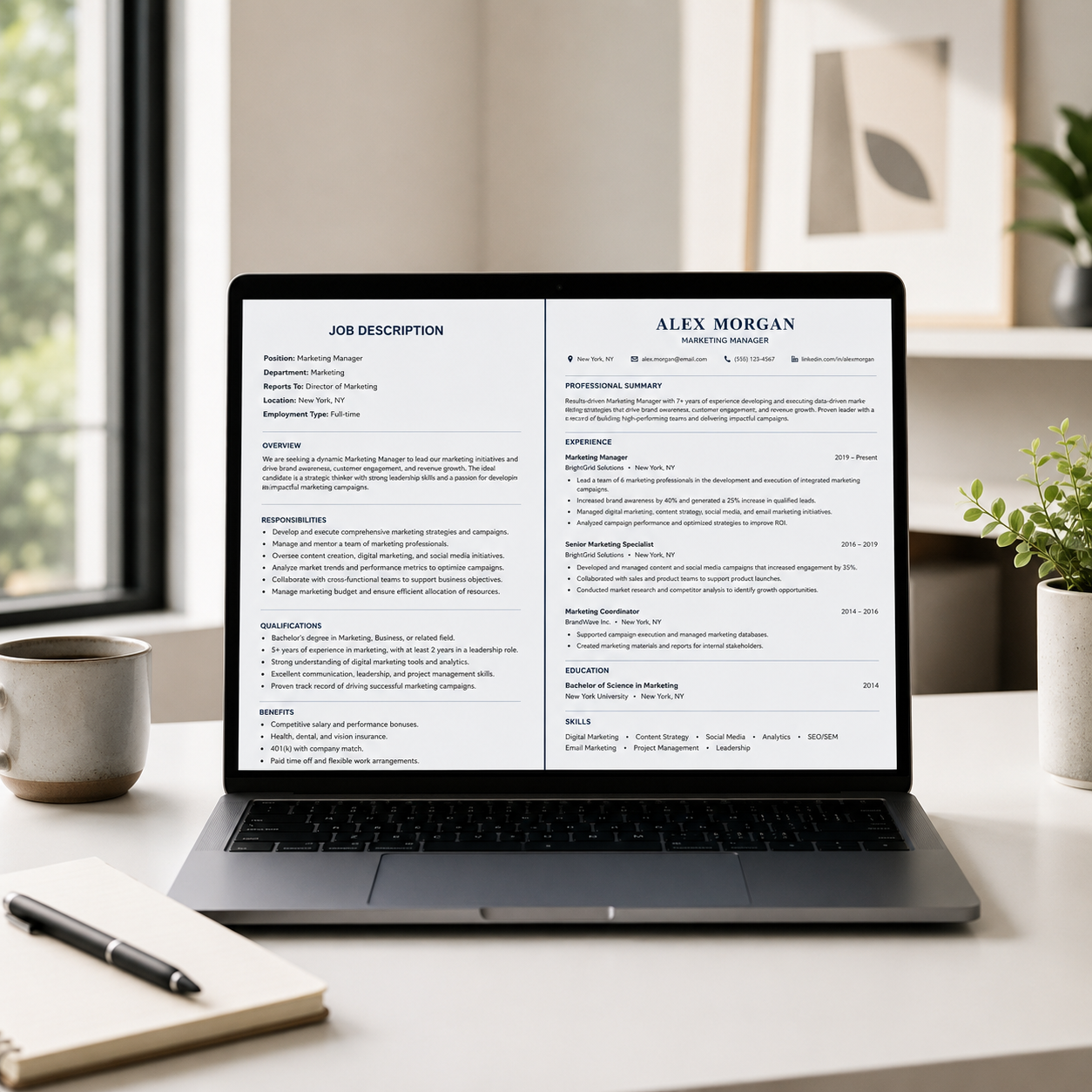
The Invisible Wall in Your Job Search
You’ve been there. You find a job posting that feels like it was written specifically for you. You have the years of experience, you’ve mastered the required tools, and you’ve delivered the exact results the company is looking for. You spend an hour polishing your resume, hit submit, and then... silence. Or worse, an automated rejection email arrives within four hours.
When this happens, the natural reaction is to assume you aren't qualified. But for most experienced professionals, the problem isn't a lack of skill—it's a lack of alignment. This is what we call the Alignment Gap.
The frustration of the modern job search is that you are no longer just competing against other humans; you are competing against an algorithm's interpretation of your history. If your resume doesn't speak the specific mathematical language the system is programmed to recognize, it doesn't matter how talented you are. You are effectively invisible.
What Exactly is the Alignment Gap?
The Alignment Gap is the distance between how you describe your experience and how a hiring system (or a tired recruiter) expects to see it. In the modern hiring landscape, your resume rarely reaches a human eye first. Instead, it passes through Applicant Tracking Systems (ATS) and AI-driven screening tools. These systems aren't looking for 'talent' in the abstract; they are looking for specific semantic markers that signal a match with the job description.
To understand this, you have to understand how these systems 'read.' They don't read like humans; they calculate. If a job description asks for "experience managing cross-functional stakeholder communication" and your resume says you "led weekly meetings with different departments to keep projects on track," you are describing the same thing. To a human, the match is obvious. To a mathematical model calculating cosine similarity between two sets of text, the match is significantly weaker.
The Alignment Gap happens when your real-world achievements are phrased in a way that doesn't mathematically map to the requirements of the role. You aren't unqualified; you're just speaking a different dialect than the software. When the system sees a gap, it doesn't assume you're a 'hidden gem'—it simply assigns a lower rank, and you disappear into the bottom of the pile.
The Danger of 'AI Resume Builders'
Because this gap is so frustrating, a new wave of AI resume tools has emerged. Many of these tools promise to "beat the ATS" or "guarantee an interview." If you aren't careful, these tools solve the Alignment Gap by cheating. They use generative AI to invent certifications you don't have, inflate your titles, or add bullet points about responsibilities you never held.
This creates a massive professional risk. If an AI tool hallucinates a skill onto your resume and you get the interview, you are now in a position where you have to defend a lie. When the interviewer asks for a specific example of that fabricated skill, the facade collapses. You might 'beat the AI' to get the interview, but you'll lose the job—and your reputation—the moment a human starts asking questions.
The goal shouldn't be to trick the system; the goal should be to accurately represent your existing experience in the language the system understands. There is a fundamental difference between optimization and invention. Optimization is about clarity; invention is about deception. One gets you the job; the other gets you fired during the first week.
Alignment, Not Invention: A Better Way
Real resume alignment isn't about adding keywords for the sake of keywords. It's about semantic mapping. It involves analyzing the job description to understand the core intent of each requirement and then finding the evidence in your own history that supports that intent.
For example, if a role emphasizes "operational efficiency," alignment means looking at your past projects and identifying where you saved time, reduced costs, or streamlined a process. Instead of adding the phrase "operational efficiency" randomly into a skills list, you rewrite your existing win to highlight the efficiency aspect of the work. You aren't changing what you did; you are changing how you describe the value of what you did.
This is the philosophy behind The Resume Tailor. We believe that the most effective resume is a truthful one. The tool doesn't invent experience; it audits your current resume against the job description and asks the hard questions. It might say: "You mentioned managing a team of five, but the job wants experience with remote-first leadership. Did you manage those people remotely?"
By asking these clarifying questions, the tool helps you surface the evidence that already exists in your head but didn't make it onto the page. This is how you close the gap without compromising your integrity.
The Technical Side: How Semantic Alignment Works
To close the Alignment Gap, we use a process similar to how advanced AI models handle memory and retrieval. Rather than just searching for keywords (which is what old-school ATS did), the system looks at the meaning of the text using a few key mechanisms:
- Chunking: The system breaks down both your resume and the job description into small, manageable pieces of information. This ensures that a specific achievement in your second job is compared directly against a specific requirement in the job posting.
- Cosine Similarity: This is a mathematical measure of how similar two vectors are. By converting your experience and the job requirements into vectors, we can calculate the 'distance' between them. The smaller the distance, the higher the alignment.
- Evidence Matching: When a gap is found, the system doesn't just fill it with a buzzword. It flags the gap and asks you for the specific evidence needed to bridge it. This turns the AI from a 'writer' into an 'auditor.'
- Truth-First Generation: The final output is a rewrite that emphasizes the overlap. If you truly do not have the experience for a specific requirement, the tool doesn't fake it—it simply leaves it out or flags it as a gap, ensuring you remain honest and employable.
The Practical Benefits of a Tailored Resume
When you move from a generic resume to an aligned one, you stop fighting the system and start working with it. The results are usually immediate:
- Higher Initial Ranking: Your resume is more likely to surface in the recruiter's dashboard because the semantic markers match the search queries they are using. You move from the 'maybe' pile to the 'must-read' pile.
- Faster Human Review: When a recruiter finally opens your PDF, they don't have to hunt for the relevant info. The most important evidence for this specific job is front and center. You are making it easy for them to say 'yes.'
- Greater Confidence in Interviews: Because the alignment is based on your actual history, you can speak fluently about every single bullet point on the page. There is no anxiety about 'how I phrased that' because you know the evidence is real.
- ATS-Safe Formatting: Alignment is useless if the file is unreadable. A clean, selectable-text PDF ensures that the system can actually parse the words you've carefully aligned. We use a structured output that avoids the 'fancy' layouts that often break ATS parsers.
Stop Guessing and Start Aligning
The job search is stressful enough without wondering if a software glitch is the reason you're not getting callbacks. You shouldn't have to be a prompt engineer or a career coach to get your resume noticed. You just need a tool that understands the gap and helps you close it truthfully.
Many people spend weeks tweaking a single resume, guessing which words might work, and hoping for the best. But hope isn't a strategy. The most successful candidates are those who treat their resume as a targeted document—one that changes slightly for every single application to reflect the specific needs of the employer.
If you're applying for a role you know you can do, but the system isn't seeing it, it's time to stop guessing. Focus on the evidence, align your language, and get your experience in front of the people who matter.
Ready to close the gap? Align your resume today.