The Noise Floor of Modern Software
If you open your phone right now, you are likely staring at a dozen different icons, each one vying for your attention. But the battle isn't just for your time anymore; it's for your cognition. We have entered the era of the "Omni-Tool." Every app, from your notes to your calculator, is suddenly trying to be a co-pilot, a strategist, and a life coach. They don't just want to execute a task; they want to suggest how you should think about that task, automate the process, and summarize the result before you've even had a chance to process the data yourself.
This is the birth of AI fatigue. It is the subtle, grinding exhaustion that comes from software that never stays quiet. When every tool is "smart," the user is relegated to the role of a supervisor—constantly reviewing, correcting, and managing the AI's interpretations rather than simply doing the work. We are trading the tactile satisfaction of a tool for the managerial burden of a platform. We no longer just "use" software; we negotiate with it.
For the average iOS user, this manifests as a constant stream of "helpful" suggestions. Your email wants to write your replies; your calendar wants to optimize your day; your notes app wants to categorize your thoughts. While these features are marketed as time-savers, they often introduce a new kind of labor: the labor of verification. Every time a tool tries to think for you, you must spend mental energy ensuring it didn't hallucinate, oversimplify, or miss the nuance of your intent. This is the invisible tax of the modern app ecosystem.
The Dashboard Maze vs. The Task-First Experience
Most modern software is built on the model of the "Dashboard." The dashboard is designed to keep you inside the app. It presents you with a curated feed of insights, notifications, and "suggested next steps." While this looks efficient on a marketing landing page, in practice, it creates a Dashboard Maze. You enter the app to solve a specific problem—say, calculating a quick percentage or noting a thought—but you are forced to navigate a layer of cognitive noise before you reach the actual utility. You are greeted by "insights," "trends," and "updates" that have nothing to do with the task at hand.
Contrast this with a Task-First experience. A task-first tool has one goal: to get you from a question to an answer with the absolute minimum number of steps. It doesn't try to "engage" you. It doesn't try to keep you in the app for an extra three minutes to satisfy a retention metric. It provides a clear surface, a precise input, and an honest output. Then, it gets out of the way.
The mental cost of the Dashboard Maze is higher than we realize. Every time a tool tries to "help" you by predicting your intent, it forces your brain to switch from execution mode to verification mode. This is the essence of digital burnout: not the amount of work we do, but the amount of friction we encounter while trying to do it. When you are in execution mode, you are in a flow state. When you are in verification mode, you are an auditor. No one wants to feel like an auditor of their own productivity tools.
The Engagement Trap and the Loss of Agency
Why is so much software designed this way? Because for the last decade, the industry has been obsessed with "engagement." In the SaaS world, a tool that you use for thirty seconds and then close is viewed as a failure of retention. A tool that you spend four hours a day in is a success. This incentive structure has led to the creation of engagement traps—features designed to make software feel indispensable by making it complex.
We see this in the "Gamification" of utility. Why does a simple calculator need a social feed? Why does a journaling app need a "streak" counter? These aren't features; they are hooks. They are designed to shift your relationship with the tool from one of utility to one of dependency. When the tool becomes the center of the experience, the task becomes secondary.
When software tries to think for us, it slowly erodes our agency. When a calculator doesn't just give you the sum but "analyzes your spending patterns," it's no longer a tool; it's a lens. And when the lens is owned by a corporation that profits from your data, that lens is rarely neutral. We are craving software that doesn't have an opinion on our data, software that doesn't try to optimize our lives, and software that simply works. We are realizing that the most powerful form of intelligence is not an AI that predicts our needs, but a tool that perfectly obeys our commands.
Tactile Digitalism: A New Philosophy of Utility
At Clairos, we believe the counter-trend to AI noise is something we call Tactile Digitalism. This isn't about going back to pen and paper or rejecting technology; it's about bringing the feeling of a physical tool into the digital space. Consider a physical hammer: it doesn't suggest a better way to drive a nail, it doesn't notify you when your neighbors are hammering, and it certainly doesn't try to "summarize" your construction project. It simply provides the leverage and the weight necessary to get the job done. The value is in its reliability and its silence.
Tactile Digitalism is defined by three core principles that prioritize the human over the algorithm:
- Zero-Latency Intent: The distance between "I need to know X" and "Here is X" should be as short as possible. We eliminate the fluff—no splash screens, no AI onboarding, no "how can I help you today?" just the tool, ready for use.
- Cognitive Sovereignty: The tool provides the data; the human provides the meaning. We build tools that empower the user's intellect rather than replacing it. We believe that the act of calculating, writing, and thinking is where the value lies, not in the automated result.
- Honest Surfaces: The interface should reflect the utility. A calculator should look like a calculator. A journal should look like a page. We avoid hidden layers, algorithmic feeds, and "smart" suggestions that obscure the primary function of the app.
Applying the Quiet Approach to Daily Work
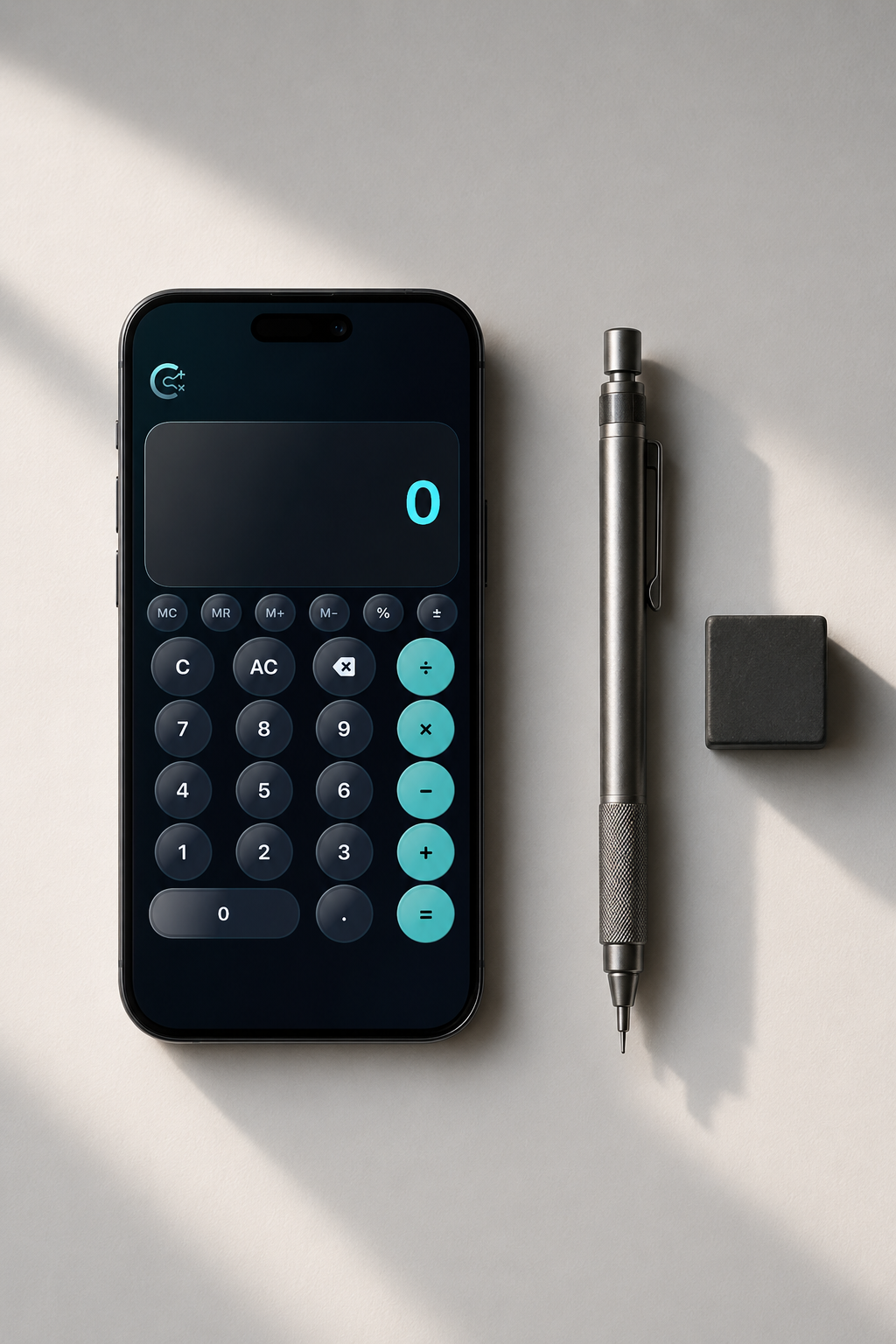
You can feel this difference in the tools we build. When you use Callie, you aren't entering a "financial ecosystem" or a "wealth management platform." You are using a high-precision utility workspace. Whether you are handling complex date math, currency conversions, or scientific calculations, the goal is a clear output, not a long-term relationship with an app. Callie is designed to be opened, used for exactly what you need, and closed. That is the definition of success for a Quiet Tool.
The same logic applies to the specialized work in Kora. Real estate professionals operate in high-stakes, live environments. They don't need a "smart assistant" to guess their commission splits or mortgage payments; they need a rock-solid set of calculators that provide an immediate, verifiable number they can trust in a live conversation with a client. In this context, "intelligence" is a liability if it introduces uncertainty. Precision is the only metric that matters.
Even in the most personal and reflective spaces, like Journal - From Me, we've intentionally stripped away the noise. Most modern journaling apps have become "content managers," pushing prompts and templates that tell you how to feel or what to record. We've removed the pressure. There are no prompts designed to keep you writing for the sake of a streak. There are no social layers or sharing buttons. It is simply a quiet place to put your thoughts, where the only "intelligence" involved is your own reflection.
The Path Forward: Reclaiming Your Focus
The industry will continue to tell you that "smarter" is always better. They will tell you that a tool that predicts your needs is the pinnacle of design because it reduces the "effort" of thinking. But there is a fundamental difference between reducing friction and reducing thought. Friction is a technical problem; thought is a human necessity.
When we outsource our basic cognitive tasks to "smart" tools, we don't actually save time—we just lose the habit of focus. We become dependent on the tool to tell us what is important. The most luxurious feature a piece of software can offer in 2026 is not a new AI integration, but silence. The ability to enter a digital space and know that nothing is trying to manipulate your attention or steer your thinking is the new gold standard of user experience.
We don't need our tools to be our partners, our coaches, or our replacements. We need them to be tools. By choosing software that respects your agency and minimizes your cognitive load, you aren't just being "minimalist"—you are reclaiming your mental sovereignty.
If you're tired of the noise, we invite you to explore the Clairos suite. We aren't building a platform to manage your life or an AI to think for you; we're building the quiet tools you need to actually live it.