The Tension Between the Estimate and the Exact
We have all been there: you are in the middle of a conversation, a number comes up, and you have a choice to make. You can either spend the next ten seconds squinting at the ceiling, trying to carry a one in your head while the other person waits, or you can reach for your phone and get the answer in two seconds.
On the surface, the digital answer is always faster and always more accurate. But there is a hidden cost to that speed—a shift in attention, a break in the flow of a social interaction, and a reliance on a device that can sometimes feel like a barrier. The real question isn't whether digital tools are better than mental math; it's knowing which one is the right tool for the specific moment.
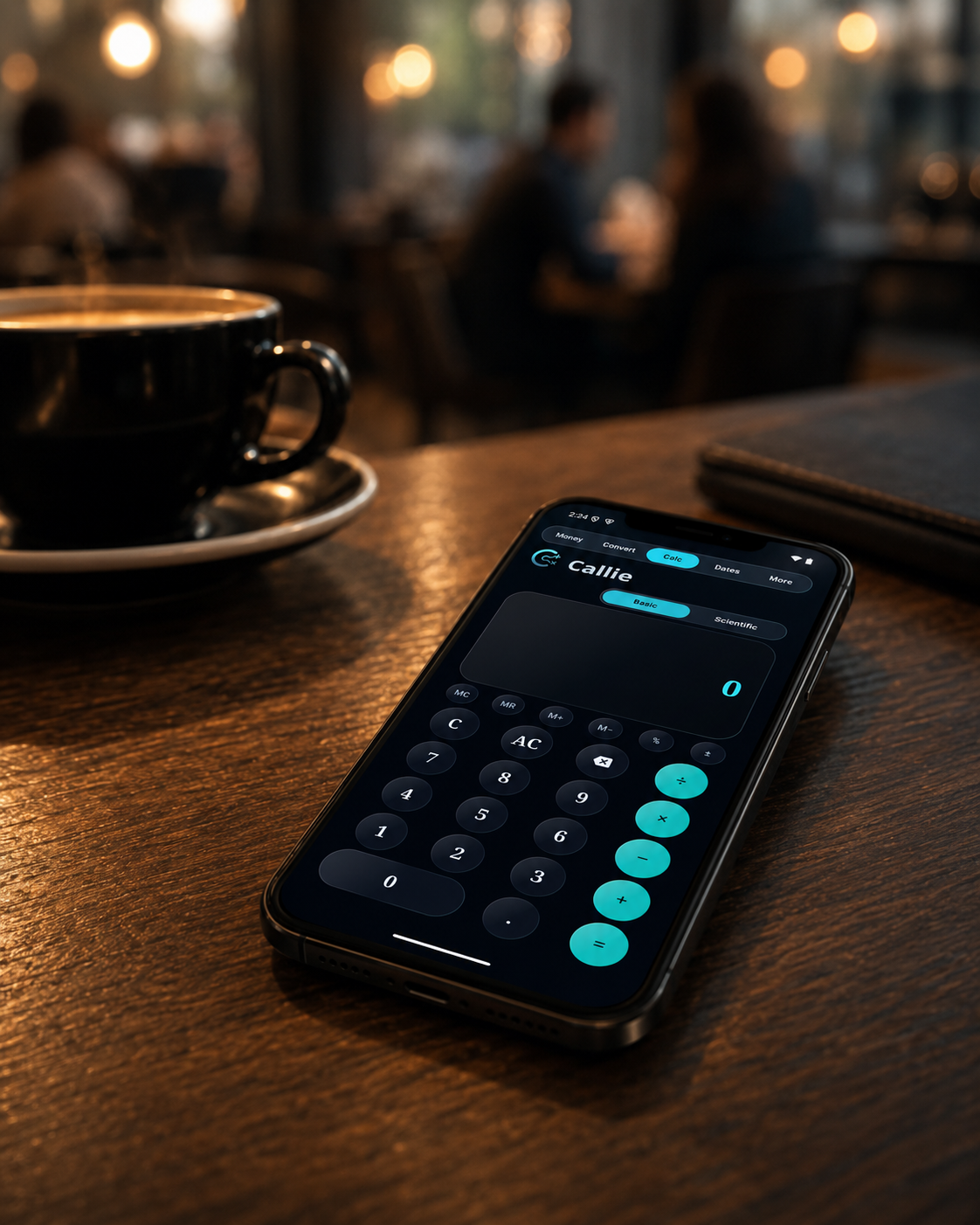
At Clairos, we build tools like Callie to be a safety net, not a crutch. The goal isn't to replace your ability to think through a problem, but to remove the friction of the arithmetic so you can get back to the actual decision-making. This isn't about the philosophy of intelligence; it's about the logistics of energy. Here is how to navigate the line between trusting your head and reaching for the app.
The 'Ballpark' Zone: When to Trust Your Head
Mental math isn't about precision; it's about scale. In most daily interactions, you don't actually need the exact number—you need to know if you are in the right neighborhood. This is the "Ballpark Zone," and it is where your brain is actually more efficient than any app because it eliminates the physical act of retrieval.
The beauty of the ballpark is that it allows for momentum. When you are in a flow state—whether that's a brainstorming session or a casual chat—stopping to find an app can kill the energy of the moment. If you can get within 5% of the answer in under three seconds, your head is the fastest tool available.
Here are the primary scenarios where mental math is the superior choice:
- Social Momentum: When you are splitting a dinner bill or estimating a tip, the social cost of pulling out a phone often outweighs the benefit of being accurate to the penny. A quick "let's just call it 40 bucks" keeps the conversation moving and maintains the human connection.
- The Sanity Check: Mental math is the best tool for catching "fat-finger" errors. If you type a number into a calculator and it tells you the total is $12,000 when you expected $120, your mental ballpark is what tells you immediately that something is wrong. Without a mental estimate, you are blindly trusting the machine, which is where the most expensive mistakes happen.
- Low-Stakes Decisions: If the difference between $14.50 and $15.00 doesn't change your behavior, there is no reason to introduce the friction of a device. When the stakes are low, the effort of opening an app is a waste of cognitive resources.
- Rapid Prototyping: When you're just sketching out an idea—"If I sell ten of these at fifty bucks, I've got five hundred"—the exactness doesn't matter. You are testing a concept, not auditing a ledger.
The 'Precision' Zone: When to Reach for Callie
Then there are the moments where a "ballpark" isn't enough. This is the Precision Zone, where the margin of error has actual consequences. This is where a low-friction tool becomes an essential part of your workflow, not because you "can't" do the math, but because you shouldn't have to.
You should reach for Callie when the following conditions are met:
- High-Stakes Accuracy: When you are calculating a budget, a tax obligation, or a precise measurement. In these cases, the "cost" of being wrong—even by a few dollars—is higher than the "cost" of the time it takes to open an app.
- Multi-Step Logic: Your brain is great at simple addition and subtraction, but it starts to leak data when you have to hold three different variables in your head while performing a percentage calculation. Once you hit three or more steps, the risk of a mental slip increases exponentially. This is called working memory overflow. When you reach that limit, trying to push through is just a recipe for a mistake.
- The 'Cognitive Load' Threshold: This is the most overlooked factor. If you are already stressed, exhausted, or managing a complex project, your brain's "working memory" is already full. Trying to do mental math in this state creates unnecessary stress. Using a tool like Callie isn't about a lack of ability; it's about energy management. Why waste your remaining mental fuel on long division when you can delegate it to a piece of software?
Because Callie is designed for speed and minimalism, it doesn't feel like "starting a task." It's a quick pulse of data—input, result, exit. This minimizes the transition time between your thought process and the digital answer.
The Friction of the Device
The reason many people resist using apps for simple math is the friction. Most calculator apps are bloated with functions you'll never use, or they are buried in a folder three swipes away. When the tool is cumbersome, your brain subconsciously decides that the mental struggle of doing the math is actually easier than the digital struggle of finding the app.
This is a design failure, not a user failure. When an app requires you to navigate a menu or wait for an ad to load, it is no longer a tool; it's an obstacle. This is why we emphasize digital minimalism. By curating your app drawer to prioritize high-utility, low-friction tools, you reduce the perceived cost of reaching for help.
When the tool is as fast as the thought, the friction disappears. If you find yourself struggling with a calculation for more than five seconds, you have already lost the efficiency battle. At that point, the most productive move is to stop thinking and start typing.
Creating Your Personal Calculation Protocol
To optimize your speed, you can implement a simple mental protocol to decide which path to take. This removes the "decision fatigue" of wondering if you should just try to do it in your head.
1. The Two-Second Rule
Attempt the math. If the answer doesn't jump out at you within two seconds, stop. Don't enter the "squinting phase." Open Callie immediately. The two seconds you spend trying to remember if 15% of 64 is 9.6 or 8.4 is time wasted. If it's not instant, it's a task for the app.
2. The Stakes Assessment
Ask: "Does the exact cent change my next move?" If you are deciding whether to buy a coffee or a latte, a ballpark is fine. If you are calculating the remaining balance on a credit card to avoid a fee, go digital. If the answer determines a financial or professional outcome, the head is for the strategy, and the app is for the verification.
3. The Mental Energy Check
If you are in a high-pressure environment (like a client meeting or a deadline), delegate the arithmetic to the tool. Save your cognitive energy for the high-level synthesis and communication, not the basic addition. When your brain is focused on the "Why," let the software handle the "How much."
Case Study: The Client Walkthrough
Imagine you are a real estate agent showing a property. A client asks, "What would the monthly payment be if we put 20% down and the rate is 6.5%?"
The Wrong Approach: You try to do the math in your head. You pause for 15 seconds. You look uncertain. You give a ballpark that is slightly off. The client notices the hesitation and subconsciously wonders if you're guessing on other things, too.
The Hybrid Approach: You give an immediate, confident ballpark: "It'll be roughly in the $2,400 range." This shows you know your market and the general numbers. Then, you say, "Let me get you the exact figure," and you open Callie. You enter the numbers, get the precision, and present it. You've used your head for the confidence and the tool for the credibility.
Conclusion: The Hybrid Approach
The goal isn't to choose one over the other, but to operate as a hybrid. Trust your head for the direction and trust the tool for the destination.
When you use mental math for the ballpark and a tool like Callie for the precision, you get the best of both worlds: the intuition and speed of human thought combined with the absolute reliability of digital logic. It is the same principle we apply to all our work at Clairos—reducing the cost of complexity so that the tool stays out of the way of the vision.
Stop fighting with the numbers in your head when the answer is a tap away. Use your brain for the big picture, and let Callie handle the decimals.