
The Noise of Generation
If you look at the current landscape of AI tools, the promise is almost always the same: automation through generation. We are being sold bots that can write our emails, draft our contracts, and simulate our personalities. For the average consumer, this is a novelty. For a real estate professional, it is a liability.
In professional real estate, the cost of a hallucination isn't a funny typo in a social media post; it is a failed deal, a lost client, or a professional embarrassment. When a client asks for a Debt Service Coverage Ratio (DSCR) or a Cap Rate, they aren't looking for a "creative interpretation" of the numbers. They are looking for the truth. The problem with generative AI is that it is designed to be plausible, not necessarily accurate. It is a language engine, not a math engine. It predicts the next likely word, not the next correct digit.
With KoraAI, we are taking a fundamentally different path. We aren't building a bot to do your work for you. We are building an analytical engine designed to give you the leverage to do your work better. We are shifting the focus from generation to synthesis. The goal isn't to replace the agent's voice, but to arm that voice with an unshakeable foundation of data.
The Trinity of Truth: How KoraAI Actually Works
To solve the reliability problem, we have structured Kora around a three-layer architecture. We call this the Trinity of Truth. By separating the raw data, the mathematical proof, and the analytical insight, we ensure that the user never has to guess whether a number is real or "AI-generated." This hierarchy ensures that intelligence always sits on top of truth, never instead of it.
1. The Foundation: Government Data (The Pulse)
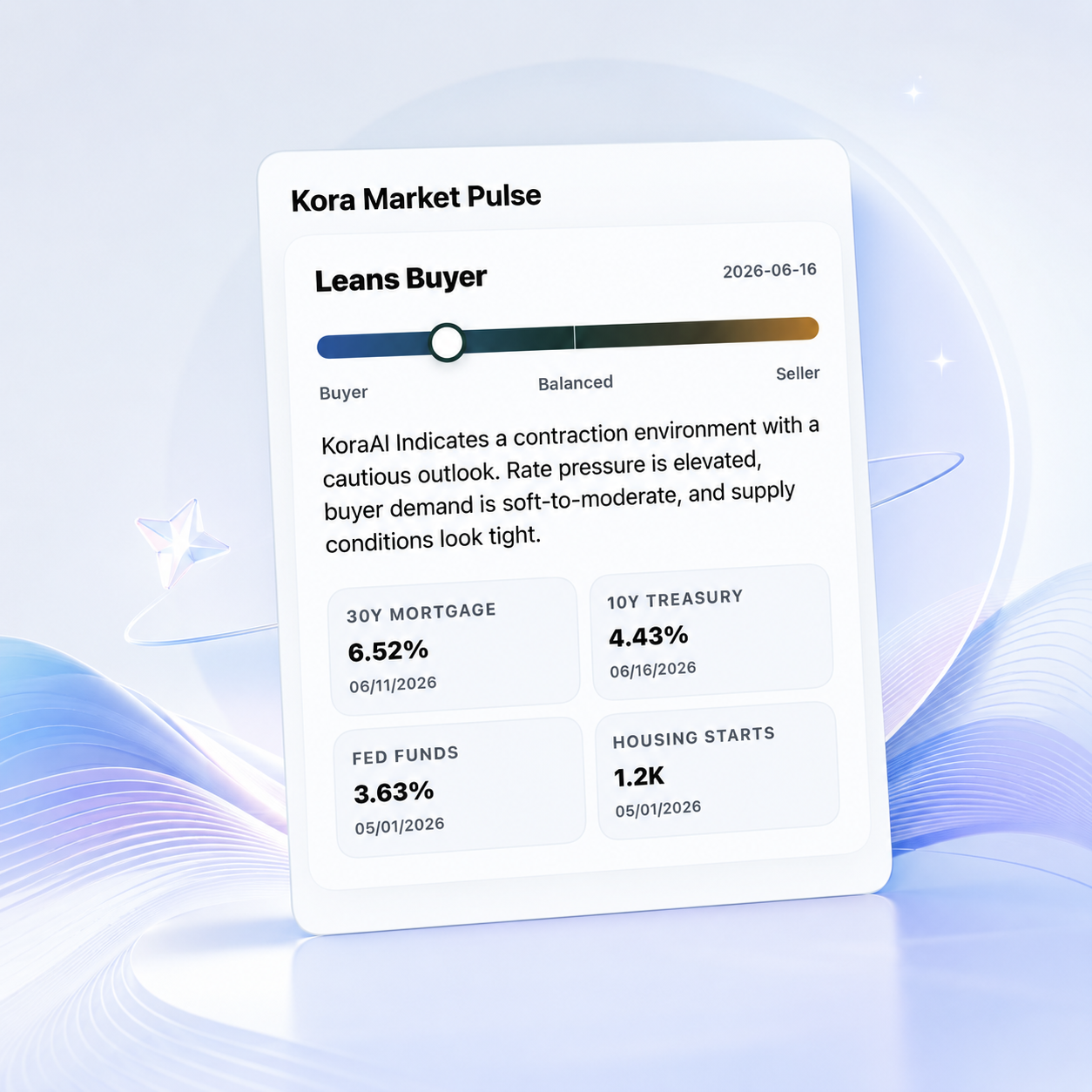
Everything starts with the raw truth. Kora doesn't scrape random forums or rely on outdated third-party blogs. We anchor our system in official government statistics and real-time economic indicators. This is what drives Kora's Market Pulse.
By monitoring these stats as they are released, from Treasury yields and inflation markers to housing start data and regional census shifts, we keep a finger on the actual heartbeat of the market. We treat this data as the immutable baseline. Before a single calculation is made or a single insight is synthesized, the system is grounded in official evidence. This means when Kora identifies a market shift, it isn't "guessing" based on a training set from two years ago; it is reacting to the numbers as the government releases them. This ensures that the agent is operating from a position of factual authority, not anecdotal conjecture.
2. The Guardrail: Deterministic Math (The Proof)
Here is the most important rule of Kora's architecture: The AI does not do the math.
Mortgage calculations, amortization schedules, DSCR, and underwriting are not "suggested" by a model; they are executed by a deterministic, rule-based engine. This is the same logic used by CPAs and financial analysts. If you input X and Y, you will always get Z. There is no variance, no randomness, and zero chance of hallucination.
By keeping the core outputs deterministic, we provide an auditable trail. In a world of "black box" AI, KoraAI's math is transparent. When an agent presents a report to a client, they can stand behind every decimal point because those numbers were produced by immutable mathematical rules, not by a transformer model trying to predict a sequence of tokens. This is the difference between a guess and a proof.
3. The Lens: The Custom 600M Transformer (The Insight)
If the government data is the foundation and the math is the guardrail, the AI is the lens. We have implemented a custom 600-million parameter transformer model specifically trained for property-focused workflows.
It is critical to understand that this model is not a chatbot. It doesn't "work on its own," and it doesn't try to replace the agent's expertise. Instead, it uses the inherent nature of transformer models—their ability to recognize complex patterns across massive datasets—to analyze the market. It looks at the government data and the deterministic math and identifies the meaning behind them.
For example, while the deterministic engine calculates a specific cap rate, the transformer analyzes that rate against regional trends and government data to provide a contextual interpretation. It doesn't generate a fake story; it synthesizes a professional insight. It tells the agent why the numbers matter, allowing the agent to provide the high-level strategy to the client. The AI provides the pattern; the professional provides the judgment.
Architecture for Speed and Scale
One of the biggest frictions with modern AI is the "latency gap"—the awkward pause while a model thinks. Most apps solve this by making a new API call every time a user clicks a button, which is both slow and expensive, creating a fragmented experience that feels like a conversation with a slow machine.
We designed Kora's architecture to scale without excessive calls. Instead of re-running models for every individual user, we utilize a tiered serving system. We run a national analysis. The resulting intelligence is then served to the users in the US. This means the AI feels instantaneous. The insight is already there, waiting for the agent, because the heavy lifting was done at the systemic level, not the individual request level.
This approach aligns with our broader philosophy of building quiet tools. The technology should be invisible. The agent shouldn't feel like they are "using an AI"; they should feel like they have a sudden, profound clarity about the market. We've removed the friction of the "prompt" and replaced it with the efficiency of the "result."
The Professional Identity: The Brand Genesis
Technical power is useless if the delivery feels clinical or generic. The "wow moment" of Kora 1.5 isn't just the math—it's the identity. We've introduced a Brand Import wizard that transforms Kora from a generic tool into a professional extension of the agent's own business.
By importing a logo or a brand guide, the app immediately adopts the agent's visual language. When the analytical engine produces a report, it isn't a "Kora Report"; it is a professional document that looks and feels like it came from the agent's own office. This closes the gap between the data and the delivery, allowing the agent to move from analysis to presentation in seconds. It turns a utility into a brand asset.
Agent-First, Not Agent-Replacement
The industry is currently obsessed with "replacing" the human in the loop. We believe that is a fundamental misunderstanding of the real estate profession. Real estate is a business of trust, nuance, and human relationship. No model—regardless of its parameter count—can replace the intuition of an experienced agent who knows the neighborhood, the hidden motivations of a seller, or the specific needs of a first-time buyer.
Kora is designed as a professional exoskeleton. We provide the data, the math, and the analytical synthesis, but the agent provides the judgment. We aren't doing the work for you; we are giving you the tools and the data you need immediately so that you can spend less time in a spreadsheet and more time in front of your clients.
We are moving away from the era of the "AI Assistant" and into the era of the "Analytical Engine." In Kora 1.5, the intelligence is there to support your brilliance, not to simulate it. You don't need a bot to tell you how to be an agent; you need a high-precision instrument that tells you exactly where the market is moving, so you can lead your clients with confidence.