
Real estate has no shortage of software.
There are tools for property data. Tools for market research. Tools for financial analysis. Tools for documents, marketing, transaction management, and reporting.
The problem is that most of them understand only one piece of the property at a time.
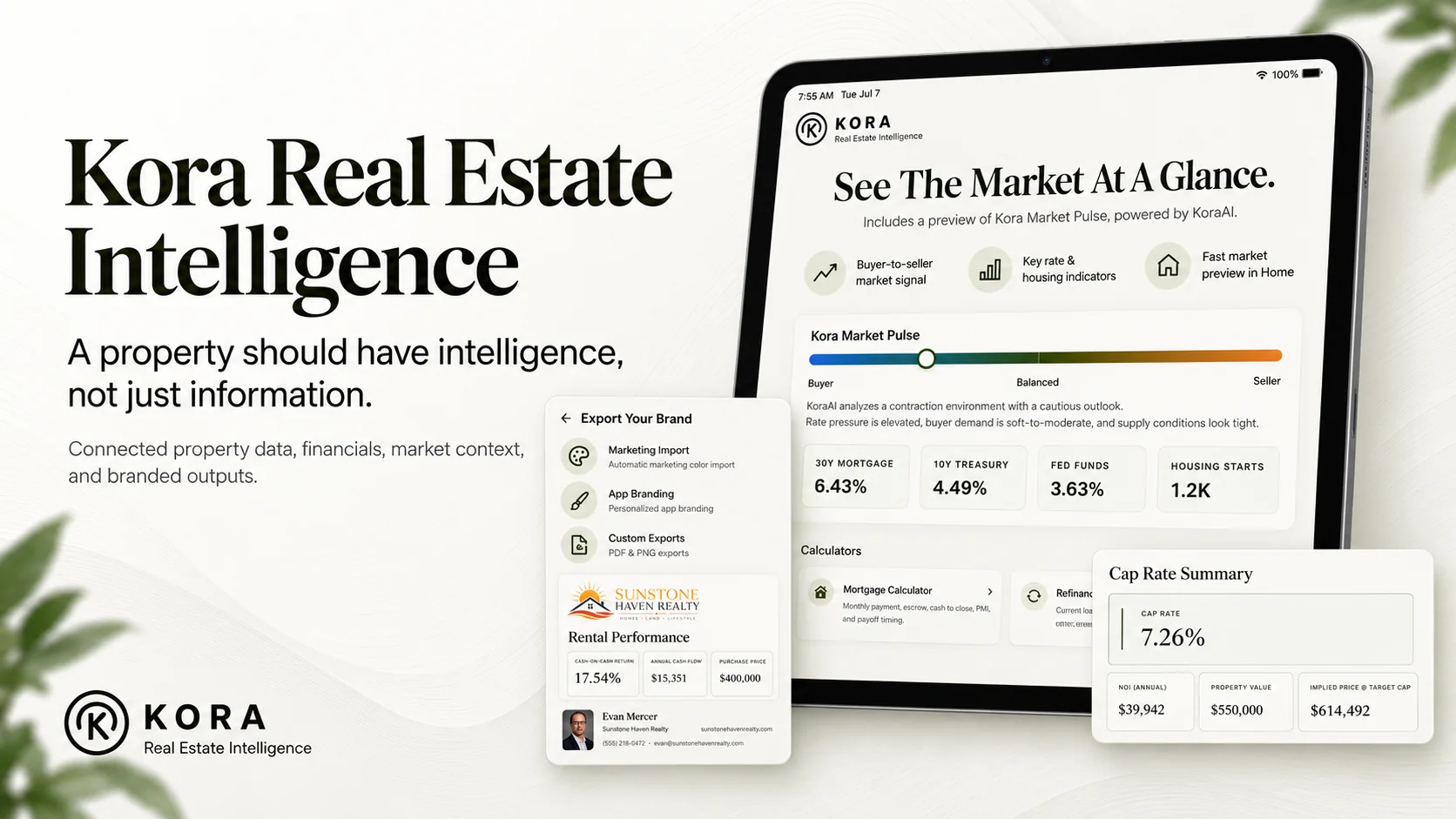
Kora Real Estate Intelligence is being built around a different idea: a property should have an intelligence layer, not just a folder of information.
That idea is becoming the foundation of the next generation of Kora.
From Real Estate Software to Property Intelligence
A real estate professional rarely makes a decision from a single number or document.
Understanding a property means connecting its physical characteristics, financial performance, location, market conditions, documents, history, and intended use.
Those pieces affect one another.
A rent roll means more when it can be considered alongside operating expenses. A property's income means more in the context of its market. A listing becomes more useful when the underlying property data, location intelligence, financial information, and supporting documents are already understood.
Kora Real Estate Intelligence is designed to bring those pieces together around the property itself.
Instead of repeatedly moving information between disconnected tools, Kora is being built to create a persistent understanding of the property and use that understanding throughout the real estate workflow.
One Property. One Intelligence Layer.
At the center of Kora is a simple shift in how real estate information is organized.
The property becomes the primary object.
Documents, financials, location data, market context, analysis, photographs, reports, and generated materials all contribute to a shared understanding of that property.
That intelligence can then be used to create useful outputs without starting from zero every time.
This is particularly important in real estate, where the same underlying information is often reused across analysis, presentations, marketing materials, conversations, and transaction workflows.
Kora is being designed so that the work done to understand a property remains useful.
Residential Real Estate Intelligence
Kora's residential experience is focused on turning property information into clear, polished, usable intelligence.
Property details, imagery, location context, market information, and other relevant inputs can contribute to a more complete picture of the home rather than existing as isolated data points.
From that understanding, Kora can help produce professional property materials and concise real estate insights while keeping the property itself at the center of the experience.
The goal is not to generate more noise.
It is to reduce the amount of repetitive work required to go from raw property information to something genuinely useful.
Income-Producing and Commercial Property Analysis
Income-producing real estate makes the need for connected intelligence even more obvious.
A commercial or multifamily property cannot be understood from photographs and listing information alone.
Rent rolls, profit and loss statements, operating expenses, unit information, income, occupancy, and property characteristics all contribute to the financial reality of the asset.
Kora Real Estate Intelligence is being developed to work directly with this kind of information and turn it into a coherent property-level analysis.
Rather than treating financial documents as attachments that simply sit beside a property, Kora can use them as part of the property's intelligence.
That means bringing together information such as:
- Rent rolls and tenant or unit-level information
- Property income and operating expenses
- Profit and loss statements
- Occupancy and revenue characteristics
- Property and location data
- Market and economic context
- Supporting documents and source material
The result is intended to be more than another generated commercial real estate report.
The report is an output.
The intelligence behind it is the product.
Financial Truth Should Stay Connected to the Source
Real estate financial analysis becomes dangerous when polished presentation begins to outrun the underlying numbers.
Kora's approach is being designed around keeping financial intelligence tied closely to the source information used to create it.
When the underlying financial data changes, the property intelligence should be able to reflect that change deliberately rather than quietly drifting away from reality.
This is an important distinction in the design of Kora.
Artificial intelligence can help interpret, organize, summarize, and connect information, but authoritative numbers still need to remain grounded in the property's actual financial data.
Kora is being built with that separation in mind.
Real Estate Market Intelligence in Context
Properties do not exist in isolation.
Local demographics, housing conditions, economic activity, development, employment, market movement, and broader location trends can all affect how a property should be understood.
Kora's longer-term intelligence model connects this external context to the property instead of forcing users to research it separately and manually reconcile the results.
The objective is not to bury users in statistics.
It is to surface the market context that actually matters to the property being evaluated.
Intelligence That Persists
One of the biggest problems with many AI tools is that every interaction feels temporary.
Upload the documents. Explain the situation. Generate an answer. Close the session. Then repeat the process again later.
That model makes little sense for real estate.
Properties exist for years. Transactions last weeks or months. Financial information evolves. New documents arrive. Market conditions change.
Kora is being designed around persistent property intelligence so useful work does not disappear simply because a report has already been generated.
Existing intelligence can remain available while updated information is processed deliberately.
That creates a much more natural relationship between the underlying property, its changing information, and the outputs produced from it.
AI Should Remove Work, Not Create Another Workflow
There is a growing category of software that adds artificial intelligence without actually making the underlying job easier.
Users still gather the same information, organize the same files, fill out the same forms, move data between the same systems, and then manage an AI interface on top of everything else.
Kora is being built with the opposite goal.
Intelligence should quietly reduce repetitive work.
Expensive analysis should happen when it is actually needed. Existing results should remain available. Financial information should stay trustworthy. Property context should be reusable. Reports and presentations should emerge from the intelligence already assembled around the property.
The user should spend less time operating the software and more time understanding the real estate.
Built Around the Property
The larger vision for Kora is not simply a better report generator, listing tool, commercial real estate calculator, or property marketing application.
Those capabilities matter, but they are pieces of something larger.
Kora Real Estate Intelligence is being built as an intelligence system centered on the property itself.
A place where property data, documents, financial performance, market context, location intelligence, analysis, and real estate workflows can increasingly operate from the same underlying understanding.
Residential and income-producing real estate are the beginning of that system.
What Comes Next
Development of Kora Real Estate Intelligence is continuing now, with a particular focus on making the experience fast, accurate, deliberate, and genuinely useful in real-world property work.
We will be sharing more of the interface, property intelligence capabilities, financial analysis, and broader Kora platform as development progresses.
But the idea at the center of it is unlikely to change:
A property should not just have data.
It should have intelligence.
That is what we are building with Kora.