A Quiet Place to Write: Introducing Journal - From Me
We are living through the era of the infinite scroll. Every second of our waking lives is spent navigating a stream of information that never ends, never pauses, and rarely asks us how we actually feel about it. Our digital tools have become mirrors of this chaos—dashboards, notifications, feeds, and "productivity" apps that treat our inner lives like a series of tasks to be optimized.
I wanted something different.
I wanted a space that didn't feel like software. I wanted a tool that didn't want anything from me—no account to create, no profile to maintain, no "streak" to keep alive, and absolutely no algorithm trying to nudge me toward a specific mood. I wanted a digital sanctuary that felt as honest and steady as a physical notebook.
That is why I built Journal - From Me.
The Digital Notebook That Actually Feels Like Paper
Most "note" apps are just blank white canvases. They are sterile. They feel like Word documents or spreadsheets, which makes them great for work, but terrible for reflection. When you open a work document, your brain switches into "output mode." You start thinking about efficiency, formatting, and completion.
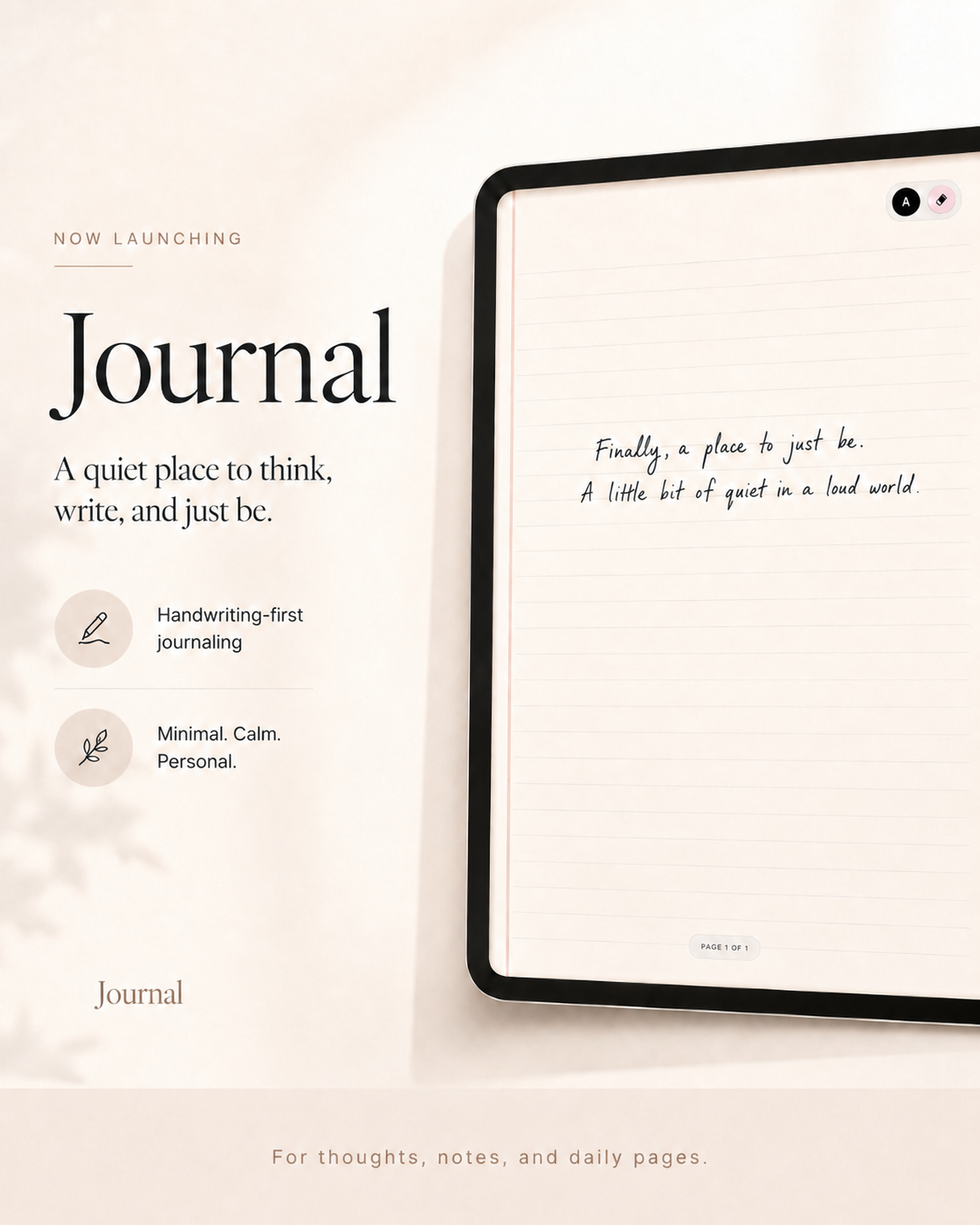
Journal - From Me is designed to trigger a different part of the brain. The UI isn't just "minimalist"; it's intentional. We used a light, ruled paper aesthetic that mimics the tactile experience of a real journal. When you use the Apple Pencil on the iPad, it isn't just about "input"—it's about the connection between the hand and the thought.
The goal was to create a surface, not an editor. By removing the heavy chrome, the complex toolbars, and the distracting menus, the app disappears. What's left is just you and the page. It’s a quiet, cream-colored space where the only thing that matters is the ink you put down or the words you type.
Turning Pages, Not Scrolling Feeds
One of the most subtle but profound changes we made was the way you move through your writing. In almost every modern app, you scroll. You swipe up and down in a continuous, frictionless loop. But scrolling is the language of the feed; it’s the language of consumption.
In Journal - From Me, you turn pages.
There is a psychological shift that happens when you move from a scroll to a page-turn. A page has a beginning and an end. It has a boundary. When you turn a page like a book, you are making a conscious decision to move forward or look back. It creates a sense of closure.
This design choice is an act of rebellion against the "infinite" nature of the internet. By giving your thoughts a physical boundary, the app encourages you to slow down. It transforms the act of journaling from a data-entry task into a rhythmic, meditative process. You aren't just "logging data"—you are writing a book of your life.
Preserving the Moment: The Integrity of the Past
In the digital world, everything is editable. We can go back and change a tweet, edit a caption, or rewrite a document until it looks perfect. But a journal isn't supposed to be perfect; it's supposed to be true.
One of the most important features of the Journal is the way it handles time. While today’s entry is your open playground, the app is designed to protect your previous entries. It treats your past memories with a certain kind of reverence, locking them in the moment they were written.
Why do this? Because the value of a journal isn't in the "correctness" of the writing—it's in the honesty of the perspective. When you look back at an entry from six months ago, you don't want to see a polished, edited version of your thoughts. You want to see exactly how you felt in that moment, including the confusion, the raw anger, or the naive hope. By discouraging the urge to "clean up" the past, the app ensures that your memories remain authentic artifacts of who you were.
Yesterday, Through You: Processing the Noise
We can't ignore the world we live in. For many of us, the news cycle isn't just a source of information; it's a source of constant, low-level anxiety. We are bombarded with global tragedies and geopolitical shifts, and often, we don't have a healthy way to process that weight. We either scroll past it in a state of numbness or we spiral into outrage.
Yesterday, Through You (YTY) was created to bridge that gap. It is a standalone reflection space that asks you to do something different: stop analyzing the news and start processing it.
Every day, YTY offers you seven broad, inward-facing prompts based on world events. But these aren't political quizzes or news summaries. They are invitations to reflect on how a world event echoes in your own life. Instead of asking, "What happened in the news today?" it asks, "How did this event make you feel? Where did you feel it in your body? What does it remind you of in your own history?"
By selecting one prompt and writing a reflection, you turn a chaotic global event into a personal, manageable insight. It transforms the news from something that happens to you into something you can observe and integrate. It is a tool for the Conscious Observer—someone who wants to stay aware of the world without being consumed by it.
Privacy by Design: Your Thoughts Are Yours
Finally, we had to address the "elephant in the room": privacy. In an age where our most private thoughts are often used to train LLMs or sold to advertisers, the idea of a "cloud journal" can feel invasive.
Journal - From Me is local-first.
There is no sign-in screen. There is no backend server reading your entries to "improve your experience." Your writing lives on your device. If you choose to use iCloud, it syncs through your own private Apple account—meaning the data stays within your own encrypted ecosystem.
We believe that for a journal to be truly useful, it must be a safe space. The moment you feel like you are being watched—even by a benevolent AI—you stop being honest. By removing the account system entirely, we've removed the barrier between you and your truth.
A Return to the Page
Journal - From Me isn't trying to be the "ultimate productivity suite." It isn't trying to organize your life, manage your projects, or optimize your habits. It is doing something much simpler, and perhaps much harder: it is giving you a place to be still.
It is an invitation to put down the feed, pick up the pen, and remember what it feels like to simply exist on a page. No noise. No pressure. Just you, and the quiet honesty of the present moment.
Welcome to the sanctuary.